Nous sommes confrontés à un paradoxe en matière de gestion des ressources. Les organisations ont massivement investi dans des outils de gestion de projets (Jira, Asana, Monday.com, Smartsheet, etc.). Pourtant, la question la plus fondamentale reste sans réponse claire :
« Qui est disponible pour prendre en charge ce projet le mois prochain ? »
Nous avons digitalisé les tâches, sans pour autant mettre fin au chaos. Et c'est bien là le cœur du problème : les études montrent que seulement 27 % du travail est réellement aligné sur les objectifs stratégiques. Le problème ne vient pas d'un manque d'outils, mais d'un manque de connexion entre eux.
D'où vient cet angle mort dans la gestion des ressources ?
Selon une étude récente de PM Solutions, le principal point de défaillance dans la gestion des ressources aujourd'hui ne réside pas dans l'identification des ressources, mais dans l'intégration des données. Les organisations sont submergées par des informations fragmentées, tandis que les données critiques sur la capacité restent cloisonnées dans des systèmes distincts.
Cependant, les silos de données ne représentent que la partie technique du problème. Une autre difficulté, liée aux environnements de travail, s'y ajoute : les équipes fonctionnent selon des modes très différents. Certaines sont Agile, d'autres suivent des méthodologies en cascade, et beaucoup adoptent des approches hybrides. Cette fragmentation, ancrée dans les pratiques et la culture, crée un problème de traduction qui dépasse la simple intégration des données.
Comment comparer la capacité d'équipes qui évaluent le travail selon des référentiels totalement différents ?
Faute de pouvoir agréger les données dispersées et faire dialoguer ces différents modes de fonctionnement, les décideurs sont contraints de piloter à l'intuition. Le rapport 2025 State of Resource Management le confirme : cette année encore, la planification de la capacité reste leur défi numéro un.
Le coût stratégique
Quand la visibilité fait défaut, les conséquences vont bien au-delà des retards de livraison. Le rapport State of the Global Workplace de Gallup révèle que le désengagement a entraîné une perte de productivité colossale de 438 milliards de dollars en 2024, avec un engagement des managers tombé à seulement 27 %. Mais le burnout n'est qu'un symptôme. Le véritable problème réside dans une allocation inefficace des ressources.
This connects directly to strategy execution. Only 20 % of executives feel confident that resources are properly allocated to execute strategy—which directly contributes to why only 27% of work aligns to strategic objectives in the first place. It’s a vicious cycle: poor visibility leads to poor allocation, which leads to strategic misalignment, which undermines confidence in the entire planning process.
Il ne s'agit donc plus d'un simple problème opérationnel. C'est un enjeu de direction générale, qui met en péril à la fois les opportunités stratégiques et la santé de l'organisation.
Comment l'IA change la donne
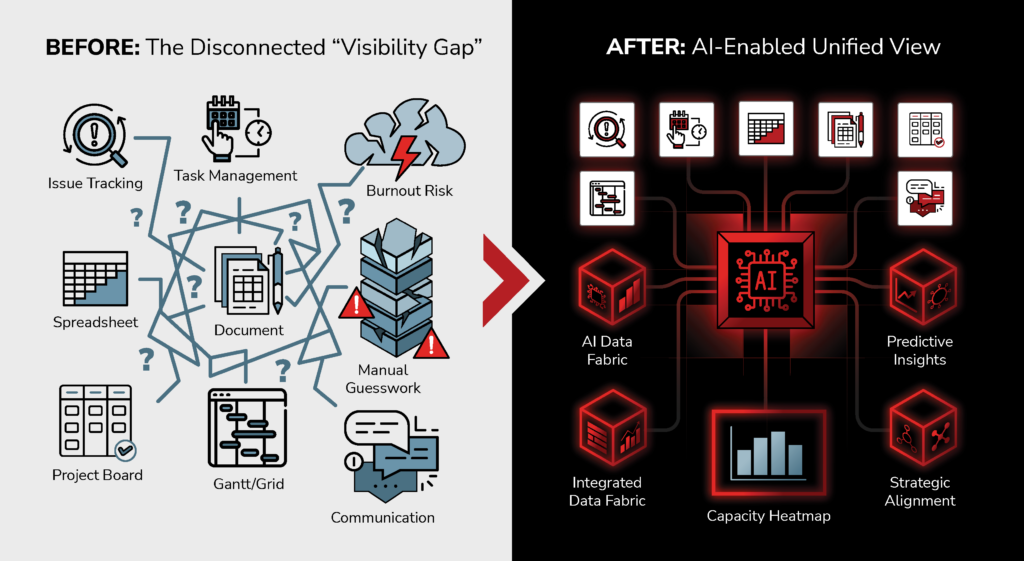
Une compréhension contextuelle entre les systèmes
Des solutions fondées sur l'IA, comme Planview Anvi, connectent des outils disparates via une architecture de données qui s'appuie sur plus de 60connecteurs. Elles offrent ainsi ce dont les responsables des ressources ont toujours eu besoin : une vue unifiée et centralisée. L'IA assure automatiquement la normalisation des données, évitant aux managers de naviguer d'un tableau de bord à l'autre pour comprendre la capacité des équipes.
Les bénéfices sont encore plus importants lorsque cette approche s'intègre à l'environnement existant, sans ajouter un outil de plus à un écosystème déjà saturé. Une IA capable de s'insérer dans les workflows en place apporte cette vision unifiée sans créer de nouvelles ruptures. Mieux encore, elle met en lumière des risques et des dépendances qui resteraient autrement invisibles jusqu'à ce qu'ils se transforment en problèmes concrets.
Une planification prédictive de la capacité
L'étude State of AI de McKinsey met en évidence un tournant majeur : les organisations les plus performantes n'utilisent pas l'IA uniquement pour automatiser, elles repensent leurs workflows de bout en bout. Dans la gestion des ressources, cela signifie que l'IA peut anticiper les goulots d'étranglement avant qu'ils ne surviennent, faisant évoluer la discipline d'une gestion réactive vers une approche véritablement prédictive.
Au lieu de découvrir un manque de ressources en cours de projet, les responsables identifient les contraintes dès la phase de planification. Ils peuvent alors arbitrer plus tôt sur les priorités, les calendriers ou les besoins en renfort.
Une optimisation fondée sur les compétences
Dans de nombreux secteurs, un défi majeur persiste : identifier avec précision les compétences déjà présentes dans l'organisation. Les études sur le déficit de compétences en IA montrent que les entreprises disposent souvent de talents inexploités, faute de visibilité suffisante pour les mobiliser efficacement.
L'IA répond à ce défi en dépassant les intitulés de poste rigides au profit d'une approche fondée sur les capacités réelles. Elle peut analyser les historiques de projets, les certifications et les modes de travail afin d'identifier la meilleure personne pour une mission, même si elle appartient à un autre département ou n'a jamais occupé exactement ce rôle. En rapprochant les compétences disponibles des besoins réels, elle révèle des talents que les outils traditionnels ne détectent pas.
De l'administration à la stratégie
L'avenir de la gestion des ressources ne repose pas sur des rapports de taux d'utilisation plus précis ni sur des diagrammes de Gantt plus sophistiqués. Il repose sur une nouvelle manière d'aborder le sujet : faire de la gestion des ressources un pilier de l'exécution stratégique, et non une réflexion tardive.
L'IA rend les engagements plus fiables et renforce l'agilité stratégique en apportant aux décideurs un élément rare : la confiance dans les données. Grâce à une visibilité fiable et prédictive sur la capacité, ils peuvent dire « non » ou « pas encore » à de nouvelles demandes, et ainsi préserver l'intégrité de la stratégie qu'ils se sont engagés à exécuter. Il ne s'agit donc pas seulement d'optimiser la gestion des ressources. C'est aussi un puissant levier de discipline stratégique.
Les organisations qui réussiront dans la prochaine décennie ne chercheront pas uniquement à maximiser leurs taux d'utilisation. Elles utiliseront l'IA pour relier la stratégie à l'exécution, en veillant à ce que les bonnes personnes travaillent sur les bons sujets, au bon moment.
Envie de découvrir comment l'IA peut aider vos équipes à créer plus de valeur ?
Regardez la démo de Planview Anvi pour voir comment l'IA conversationnelle vous permet de prendre des décisions stratégiques plus rapides, plus éclairées et plus fiables.